
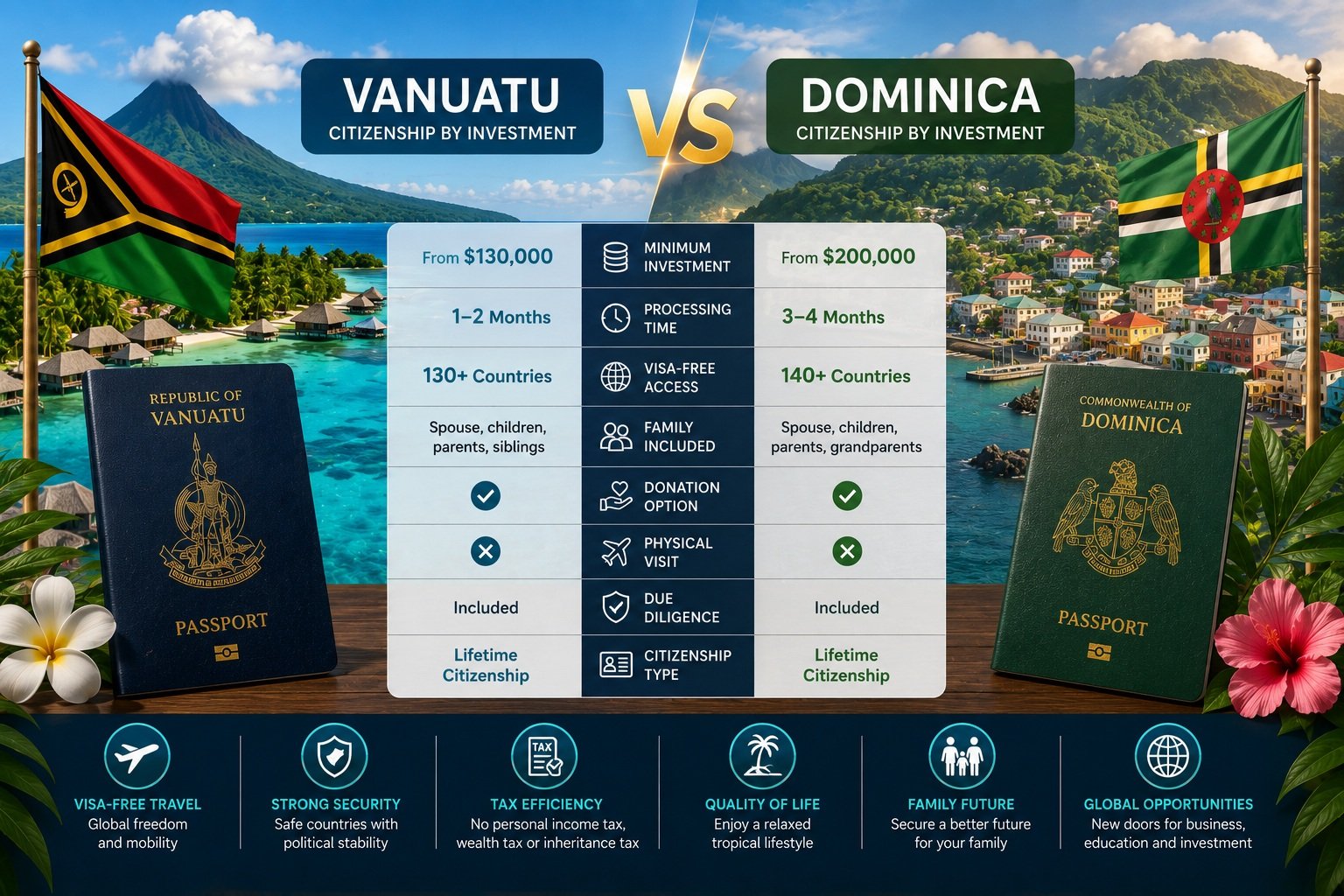
Comparing Vanuatu vs Dominica citizenship comes down to a trade a lot of applicants don’t expect: Vanuatu is faster and roughly $50,000–$90,000 cheaper for a family of four, but since late 2025 it requires a single in-person biometrics visit that Dominica still doesn’t. Vanuatu’s citizenship by investment program remains the better fit for most applicants — this guide walks through exactly where that’s true, and the specific cases where it isn’t.
Vanuatu vs Dominica citizenship: cost compared
| Vanuatu | Dominica | |
|---|---|---|
| Minimum investment (single applicant) | $130,000 (National Development Fund) or $157,000 (CNO Future Fund, family of 4) | $200,000 (Economic Diversification Fund) or $200,000 (real estate) |
| Family of 4, all-in with government fees | ~$192,150–$213,675 | ~$265,000–$270,000 |
| Refundable option | CNO Future Fund buys back $50,000 after 5 years, plus up to 5% annual return | Real estate route, exit after 3–5 years |
| Extra per dependant | $20,000 (spouse), $15,000 (child/parent) | Included up to 3 dependants at $250,000; additional dependants scale further |
Dominica’s $200,000 EDF minimum understates the real cost: the CBIU’s published fee schedule adds a $1,000 processing fee, $7,500 due diligence for the main applicant, $4,000 per dependant aged 16+, a $500 naturalisation certificate per person, and a $1,000 interview fee per person aged 16+ — pushing single-applicant totals to roughly $210,000–$215,000. Vanuatu’s fee structure is simpler and more predictable from the outset.
Timeline — and the 2025 change to “remote”
Vanuatu approves applications in around 2 months, still the fastest of any established citizenship-by-investment program. Dominica’s own CBIU FAQ states applicants should expect at least three months to approval in principle, with 4–6 months typical to passport in hand.
Here’s what changed: since late 2025, Vanuatu requires every applicant and family member to attend an in-person biometrics appointment — in Vanuatu, Hong Kong, or Dubai — with fees from roughly $1,000 to $3,000+ depending on location. (Sources differ slightly on the exact effective date — September 30, 2025 versus November 2025 — though the requirement itself is confirmed across sources.) Dominica still requires no physical presence at any stage, including its mandatory interview for applicants 16 and older.
For applicants who genuinely cannot travel, this is worth planning around. For most others, a single scheduled appointment — usually coordinated by a licensed agent — is a manageable trade-off for a program that still finishes roughly twice as fast and costs tens of thousands less.
Family rules compared
Vanuatu includes a spouse, children up to age 25, and parents from age 50, at flat fees ($20,000 spouse, $15,000 per child or parent) regardless of family size. Dominica’s 2022 regulation update removed siblings from eligibility entirely; current rules cover a spouse, children under 18, children 18–30 in full-time education and financially dependent, unmarried daughters under 25, disabled children 18+, and parents or grandparents aged 65+ who are substantially supported by the applicant. The 65-year parent threshold is notably higher than Vanuatu’s 50.
Visa-free access — the one area Dominica leads
Dominica’s passport reaches around 140–145 countries visa-free or visa-on-arrival, including the Schengen Area, per the 2026 Henley Passport Index. Vanuatu’s passport currently reaches 87 destinations according to the same index (rank 57, January 2026 release) — down after the EU suspended Vanuatu’s Schengen waiver in 2022 and the Council of the EU confirmed the exemption would end permanently in December 2024; the UK followed with its own visa requirement in 2023.
This matters specifically for applicants whose plans depend on Schengen access. For the majority whose priorities are Asia-Pacific mobility, a backup passport, or business flexibility more broadly, Vanuatu’s cost and speed advantage outweighs the narrower visa-free reach.
Tax treatment
Neither citizenship creates a tax obligation or exemption on its own — Vanuatu levies no personal income, capital gains, inheritance, or wealth tax, but only on people who are actually tax resident there; Dominica works the same way. Holding either passport while remaining tax resident elsewhere changes nothing about that home country’s tax bill.
A realistic scenario
Consider a composite example: an entrepreneur with a restrictive home passport needs a second citizenship within three months to close a deal requiring occasional Schengen travel. Vanuatu’s 2-month timeline still clears that deadline comfortably even with the biometrics appointment factored in — the visit adds days, not months. Dominica’s 4–6 month average would have missed the window. The lesson: Dominica’s remote-only process is a real advantage specifically when travel is impossible, not a default safer choice.
Which program fits which investor
For most applicants weighing Vanuatu vs Dominica citizenship, Vanuatu is the more practical choice — faster, meaningfully cheaper, and broader family terms. Dominica is worth serious consideration specifically for applicants who cannot travel under any circumstances, or whose plans depend on Schengen access. A free eligibility check through the licensed Vanuatu application process is the fastest way to see real cost and timeline for a specific nationality and family size.

Leave a Reply